
DIE CASTING MANUFACTURERS FOCUSED ON ACCURACY, DURABILITY, AND OUTPUT STABILITY
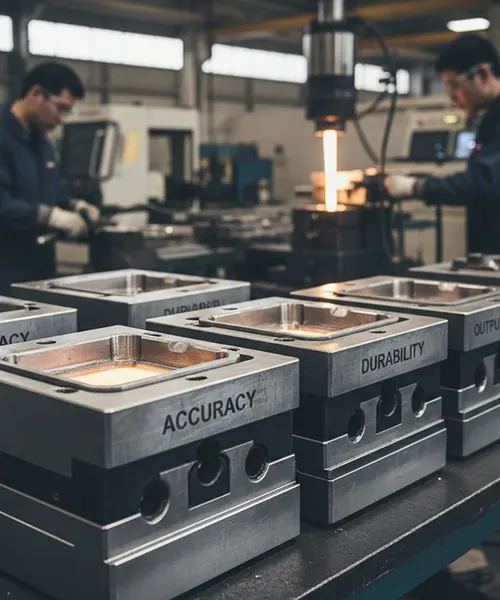
Die casting engineered for consistent performance across demanding foundry operations.
Die casting manufacturers play a critical role in determining casting quality, cycle consistency, and long-term production efficiency across foundry operations. The die directly controls metal flow, heat extraction, dimensional accuracy, and defect formation.
Well-engineered die casting enable predictable filling, controlled solidification, and repeatable part geometry across thousands of cycles. Alpha Foundry Tooling, as a die casting manufacturer, manufactures production-ready die casting with a production-first approach, ensuring consistent performance under thermal load, pressure variation, and continuous operation.
How Die Engineering Directly Impacts Casting Performance
The effectiveness of a die casting is defined by how well it manages metal behaviour, temperature gradients, and mechanical stress throughout the casting process.
A properly designed die casting helps manufacturers to:

Regulate molten metal flow paths for stable filling

Control heat dissipation to guide directional solidification

Maintain dimensional accuracy across repeated cycles

Reduce defects caused by shrinkage, gas entrapment, or distortion

Extend tool life under high thermal and mechanical loads
What Professionally Built Die Casting Enable in Production
Die casting engineered for production conditions deliver measurable operational advantages beyond part geometry.
Consistent Part Quality
Stable die geometry, precise cavity alignment, and controlled thermal behaviour ensure uniform metal flow and solidification. The result is repeatable dimensions, consistent surface finish, and reliable mechanical properties across the full production lifecycle.
Lower Scrap and Rework Rates
Engineered gating, venting, and cooling layouts limit turbulence, gas entrapment, shrinkage, and distortion. Addressing defect drivers during die design reduces rejection levels and minimises post-casting corrective operations.
Cycle Time Predictability
Balanced cooling layouts and controlled solidification patterns support stable cycle times without local overheating or uneven heat extraction. Predictable cycles improve production planning accuracy and overall equipment utilisation.
Reduced Tool Maintenance
Robust die construction, suitable tool steel selection, and effective thermal control limit thermal fatigue, cracking, and erosion. Fewer interventions are required, reducing unplanned downtime and extending effective tool life.
Production Scalability
Dies are engineered to withstand sustained output and higher cycle frequencies without compromising dimensional stability or performance. Volume ramp-up can proceed smoothly without frequent adjustments or production interruptions.
Engineering Parameters Used by Lost Foam Die Casting Manufacturers
Our manufacturing scope also supports requirements typically handled by lost foam die casting manufacturers. These dies are also used in applications where lost foam die manufacturers require precise dimensional control and thermal stability.
The table below outlines how die casting are engineered to meet production, durability, and quality requirements.
| Parameter | Engineering Considerations |
|---|---|
| Die Type Coverage | Gravity dies, low-pressure dies, permanent mould dies, and process-specific die casting |
| Tool Steel Selection | Grades selected for thermal fatigue resistance, wear life, and structural strength |
| Gating & Feeding Design | Geometry optimised for smooth metal flow and effective feeding |
| Thermal Control | Integrated cooling layouts for controlled heat extraction and solidification |
| Surface Integrity | Machining and finishing processes support dimensional accuracy and surface quality |
| Dimensional Stability | Allowances for thermal expansion, wear, and post-casting machining |
| Process Compatibility | Designed to integrate with furnaces, pouring systems, and automation |
| Production Volume Suitability | Dies are engineered for medium to high-cycle manufacturing programs |
| Validation Approach | Trial support, sampling, and iterative optimisation before serial production |
| Customization Level | Fully tailored designs based on part geometry, alloy, and process demands |
Applications Commonly Supported by Die Casting Manufacturers
Die casting are essential wherever repeatability, strength, and dimensional control are critical to performance.
Automotive structural and functional components
Powertrain and transmission housings
Electric vehicle enclosures and motor housings
Industrial machinery parts
Pressure-containing and load-bearing aluminium castings
What Sets Alpha Foundry Tooling Apart as a Die Casting Manufacturer
Successful casting programs rely on dies engineered with real-world production behaviour in mind from the outset. Alpha Foundry Tooling delivers dies built for stability, longevity, and consistent output.
Production-Oriented Die Design
Every die is engineered around actual metal flow, thermal cycling, and operational stresses—ensuring predictable performance on the shop floor.
Upfront Technical Collaboration
Early involvement allows identification of feeding challenges, cooling imbalances, and distortion risks before tooling is released for manufacturing.
Manufacturing Precision and Robustness
High-accuracy machining and controlled assembly deliver dies capable of maintaining tolerance and alignment over extended production runs.
End-to-End Program Support
Support extends from design validation and trials through production ramp-up and process stabilisation to ensure long-term operational stability.
Engage Alpha Foundry Tooling to review your die casting requirements and ensure stable, repeatable performance across production cycles.
Planning a Die Casting Program?
Early engineering alignment reduces tooling changes, improves yield, and accelerates production stabilisation. Support includes casting-method-based die evaluation, gating and cooling strategy guidance, thermal and dimensional risk assessment, and optimisation or refurbishment of existing dies.
FAQs
What is the role of die casting manufacturers in casting quality?
Die casting manufacturers define how metal fills, cools, and solidifies, directly influencing defects, dimensional accuracy, and mechanical properties.
Are Die casting customised for each component?
Die casting are engineered specifically for part geometry, alloy behaviour, and production volume requirements.
How long does a Die casting typically last?
Tool life depends on alloy, cycle time, and thermal management, but well-engineered dies are built to sustain long production runs with minimal degradation.
Can existing Die casting be improved or modified?
Yes. Dies can be upgraded with improved cooling, revised gating, or structural reinforcements to enhance performance and extend service life.