
LOW PRESSURE DIE CASTING FOR HIGH-STRENGTH ALUMINIUM COMPONENTS
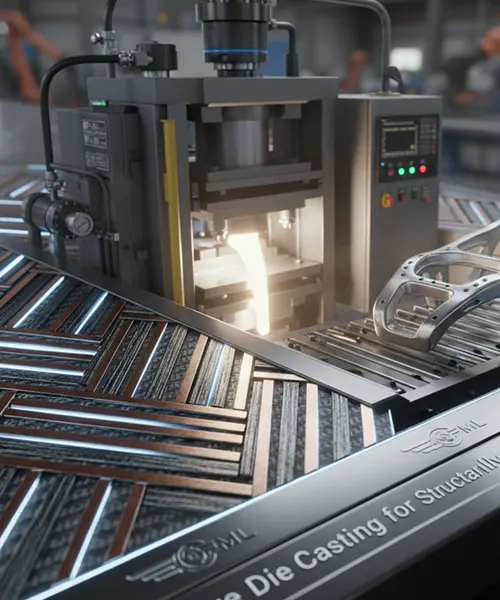
Controlled bottom-fill casting for dense, internally sound aluminium components.
Low pressure die casting (LPDC) enables controlled metal flow, bottom-fill casting, improved internal integrity, and repeatable quality for aluminium castings, while minimizing porosity and ensuring dimensional stability. The controlled casting process is widely used in aluminium die casting applications where internal quality, strength, and structural reliability are critical.
LPDC is used where internal soundness, mechanical strength, and dimensional stability are critical. Unlike gravity methods, LPDC introduces molten metal using regulated air pressure, enabling a smooth upward fill with minimal turbulence.
This controlled filling mechanism reduces gas entrapment, shrinkage defects, and random porosity, making LPDC suitable for pressure-retaining and load-bearing aluminium components. Alpha Foundry Tooling provides engineered support for Low Pressure Die Casting programs by designing dies, gating systems, and process parameters aligned with real production conditions.
Why Controlled Metal Feeding Defines LPDC Quality
The defining advantage of low-pressure die casting lies in controlled metal entry and solidification within the die. Stable pressure and directional solidification directly influence casting integrity.
A properly executed LPDC process helps manufacturers:

Achieve uniform metal flow without turbulence

Minimise internal porosity and shrinkage zones

Maintain consistent wall thickness and density

Improve mechanical properties across the casting

Reduce rejection rates in pressure-tested components
Compared to permanent mold casting and high-pressure die casting, LPDC provides better porosity control and more effective directional solidification.
What Low-Pressure Die Casting Enables in Production
This casting process is selected when performance must extend beyond appearance or basic geometry.
Enhanced Structural Integrity
Controlled bottom-fill reduces turbulence and porosity, resulting in denser castings with better strength and fatigue performance. This LPDC process optimization ensures minimal defects and improves mechanical properties across production runs.
This makes LPDC a preferred choice for automotive aluminium casting applications that require fatigue resistance, durability, and long service life.
Reduced Secondary Processing
Fewer internal defects mean less need for impregnation, welding, and corrective machining after casting.
Better porosity control in casting reduces the need for impregnation, welding, and post-processing rework in finished components.
Repeatable Dimensional Accuracy
Consistent metal flow and solidification limit distortion and maintain dimensional stability across production runs.
Improved Yield and Metal Utilisation
Directional solidification improves feeding efficiency, reducing scrap and improving usable metal output.
Process Stability at Scale
Once parameters are established, LPDC delivers reliable and repeatable results over extended production volumes.
Technical Framework of Our Low-Pressure Die Casting Support
The parameters below outline how LPDC tooling and process elements are engineered for reliability and long-term performance.
| Parameter | Technical Details |
|---|---|
| Die Construction | Permanent metal dies designed for repeated thermal cycling and pressure-assisted filling |
| Alloy Compatibility | Primarily, aluminium alloys are suited for pressure-controlled solidification |
| Filling Method | Bottom-fill via riser tube using regulated low air pressure |
| Pressure Control | Precisely managed pressure curves to match casting geometry and wall thickness |
| Thermal Management | Integrated cooling channels for controlled solidification and grain refinement |
| Process Integration | Compatibility with automated pouring, holding furnaces, and pressure systems |
| Dimensional Control | Die design accounts for thermal expansion, solidification behaviour, and machining allowances |
| Production Suitability | Medium to high-volume programs requiring consistency and structural reliability |
| Validation Support | Trial casting support, defect analysis, and process refinement during ramp-up |
| Customization Scope | Die and process parameters tailored to component geometry, alloy, and performance requirements |
Components Best Suited for Low Pressure Die Casting
LPDC is used where internal quality, pressure resistance, and mechanical strength are non-negotiable.
Automotive Wheels and Suspension Components
Electric Vehicle Motor Housings
Structural Automotive Housings
Industrial and Aerospace Aluminium Parts
Hydraulic and Pneumatic Components
Why Manufacturers Choose Alpha Foundry Tooling for Low Pressure Die Casting Programs
Low-pressure die casting success depends as much on tooling and process design as on equipment. Manufacturers work with Alpha Foundry Tooling for a disciplined, production-oriented approach to LPDC programs.
Process-Aligned Die Engineering
Die design is developed around actual LPDC pressure profiles, controlled metal flow paths, and heat extraction requirements. It ensures stable filling, proper feeding, and predictable solidification behaviour under real production conditions.
Early-Stage Technical Involvement
Engagement at the concept and design stage helps identify feeding constraints, solidification risks, and potential distortion early. Addressing these factors upfront reduces trial iterations, late-stage changes, and production delays.
Production-Ready Execution
Tooling is built for repeated thermal and pressure cycles, with robust construction and precise alignment. This supports consistent dimensional accuracy, surface quality, and process reliability across extended production runs.
Scalable Program Support
Support spans pilot trials, parameter validation, and controlled ramp-up into serial production, enabling smooth scaling without compromising casting quality or process stability.
Planning a LPDC Program?
Early technical evaluation helps avoid costly die revisions and process instability later in production.
Support includes:
- Assessment of LPDC suitability for your component
- Die and filling strategy recommendations
- Identification of porosity and solidification risks
- Optimization of existing LPDC tooling and processes
FAQs
How does low-pressure die casting differ from gravity die casting?
LPDC uses controlled air pressure to feed molten metal upward into the die, reducing turbulence and porosity compared to gravity-fed filling.
What types of alloys are commonly used in LPDC?
LPDC is primarily used with aluminium alloys formulated for controlled solidification and structural performance.
Is low pressure die casting suitable for high-volume production?
Yes. Once the process is stabilised, LPDC is well-suited for medium to high-volume production requiring consistent quality.
What defects does LPDC help minimise?
The LPDC process significantly reduces gas porosity, shrinkage defects, and random density variation, improving casting defect prevention compared to gravity or high-pressure die casting.