
CHEVRON RUBBER CONVEYOR BELT FOR INCLINED MATERIAL HANDLING
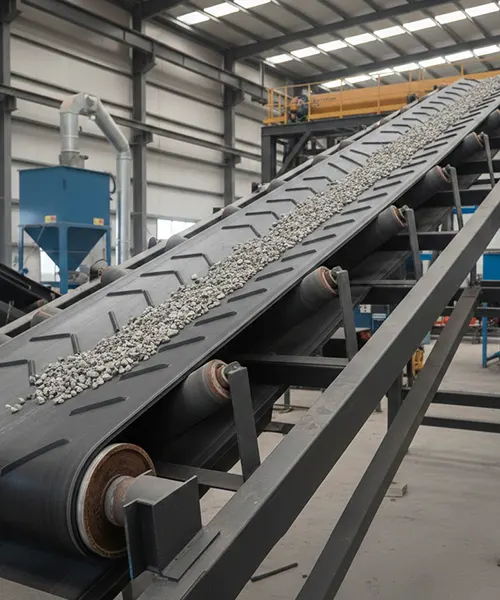
Chevron rubber conveyor belts are ideal for inclined material handling where load stability and controlled movement are critical. Variants such as sidewall conveyor belts, cleated rubber conveyor belts, and heat resistant rubber conveyor belts allow industries like mining, cement, and ports to manage bulk materials efficiently across steep or high-temperature applications.
Well-engineered rubber conveyor belts are developed around load characteristics, operating speeds, impact zones, and environmental exposure. Across mining, cement, ports, and manufacturing environments, belt performance determines system stability and maintenance frequency.
Sidewall Conveyor Belt for Steep Inclines
Sidewall conveyor belts are used when materials must be conveyed at steep angles or near-vertical inclines where standard flat belts are not effective. The integrated sidewalls help contain material on the belt surface, reducing spillage and allowing higher conveying angles within limited installation space. A sidewall conveyor belt is commonly applied in cement plants, mining operations, ports, and bulk material handling systems where elevation changes are significant.
These belts improve operational efficiency by minimising transfer points and maintaining controlled material flow even under variable loading conditions. When combined with chevron or cleated profiles, sidewall belts provide enhanced load stability and consistent throughput. Their design supports reliable performance in demanding environments where space constraints and incline requirements make conventional conveyor solutions impractical.
Cleated Rubber Conveyor Belt for Load Retention
Cleated rubber conveyor belts are designed to prevent material rollback during inclined conveying and to maintain consistent spacing between loads. The cleats act as physical barriers that hold material in place, allowing controlled movement even at higher speeds or steeper angles. A cleated rubber conveyor belt is widely used for handling bulk materials, aggregates, packaged goods, and industrial components that require secure transport.
By improving load retention, these belts reduce spillage, material loss, and cleanup requirements across the conveying system. Cleated belt designs also support stable throughput and predictable material flow, making them suitable for continuous industrial operations. When properly engineered, cleated rubber conveyor belts enhance overall conveyor efficiency while maintaining long service life under repetitive loading conditions.
Heat Resistant Rubber Conveyor Belt for High- Temperature Materials
Heat resistant rubber conveyor belts are engineered to handle materials exposed to elevated temperatures without compromising belt performance or structural integrity. These belts use specialised rubber compounds that resist hardening, cracking, and surface degradation caused by continuous heat exposure. A heat resistant rubber conveyor belt is commonly used in cement plants, foundries, power plants, and aggregate handling applications where hot materials such as clinker, ash, or processed minerals are conveyed.
By maintaining tensile strength and abrasion resistance under thermal stress, heat resistant belts help extend service life and reduce unplanned downtime. Proper material selection and compound formulation ensure reliable operation in high-temperature environments while maintaining consistent conveying performance.
How Rubber Conveyor Belt Construction Influences System Performance?
Conveyor system performance depends on how the belt manages load stress, friction, and repeated flexing over extended operating cycles.
A properly engineered rubber conveyor belt enables operations to:

Maintain stable material tracking across varying loads

Absorb impact at loading points without structural damage

Resist abrasion from sharp, coarse, or high-density materials

Minimise slippage under wet, dusty, or high-torque conditions

Sustain tensile strength over long conveying distances
Operational Advantages Delivered by Production-Grade Rubber Conveyor Belts
Rubber conveyor belts designed for real operating conditions deliver measurable benefits beyond basic material transport.
Load Stability Across the Belt Width
Optimised carcass design and uniform rubber distribution ensure even load support, reducing edge stress, misalignment, and premature belt failure during continuous operation.
Reduced Maintenance Intervals
Abrasion-resistant covers, reinforced ply construction, and fatigue-resistant compounds limit surface wear and internal breakdown, lowering maintenance frequency and unplanned stoppages.
Consistent Throughput
Stable belt tracking and controlled friction characteristics support predictable material flow rates, improving downstream process efficiency and system synchronisation.
Energy-Efficient Operation
Correct belt stiffness and cover formulation reduce rolling resistance, lowering drive power requirements and improving overall conveyor energy efficiency.
Adaptability to Harsh Environments
Belts are engineered to withstand heat, moisture, oil exposure, or outdoor weathering without rapid degradation or loss of mechanical integrity.
Engineering Factors That Define Our Rubber Conveyor Belt Manufacturing
Rubber conveyor belts are manufactured with process-specific requirements in mind rather than as standardised commodities. The table below outlines how key engineering parameters are addressed.
| Parameter | Engineering Focus |
|---|---|
| Belt Construction | Multi-ply fabric or steel cord designs selected based on load and span |
| Cover Compound | Rubber formulations chosen for abrasion, heat, oil, or chemical resistance |
| Tensile Strength | Rated to handle starting torque, incline loads, and long conveying distances |
| Impact Resistance | Reinforced zones for high-drop or heavy loading points |
| Flex Fatigue Performance | Designed to withstand repeated bending over pulleys |
| Belt Thickness | Balanced for durability without excessive system load |
| Tracking Stability | Engineered carcass symmetry to minimise belt wander |
| Operating Environment | Suitable for indoor, outdoor, wet, dusty, or high-temperature conditions |
| Conveyor Compatibility | Designed to integrate with pulleys, idlers, and drive systems |
| Application Customisation | Belt specifications tailored to material type and duty cycle |
Industries and Applications Using Rubber Conveyor Belts
Rubber conveyor belts are used in applications requiring continuous, controlled material movement at scale.
Mining and mineral processing operations
Power plants and ash handling systems
Cement plants and aggregate handling
Manufacturing lines and material transfer systems
Ports, terminals, and bulk logistics facilities
Why Choose Us as Your Rubber Conveyor Belt Manufacturing Partner?
Successful conveying systems rely on belts engineered for actual operating stresses rather than catalogue ratings. Our approach focuses on durability, tracking stability, and predictable field performance under operating conditions.
Application-Driven Belt Selection
Each belt is specified based on material characteristics, conveyor layout, and operating conditions rather than generic load ratings.
Early Technical Assessment
Load profiles, impact points, and environmental exposure are evaluated upfront to prevent premature belt failure or system inefficiencies.
Manufacturing Consistency
Controlled production processes ensure uniform belt thickness, compound integrity, and carcass alignment across the full belt length.
Lifecycle-Focused Support
Support extends beyond supply to include selection guidance, installation considerations, and performance optimisation over the belt’s service life.
Planning a Conveyor Belt Upgrade or New Installation?
Early alignment between belt design and conveyor operating conditions reduces wear, power losses, and unplanned downtime. Support includes duty analysis, compound selection, impact risk evaluation, and replacement recommendations for existing belt systems.
FAQs
How do rubber conveyor belts differ by application?
Belts vary based on material abrasiveness, load weight, temperature, and environmental exposure, requiring different carcass constructions and rubber compounds.
Are rubber conveyor belts customised or standard products?
Production-grade belts are often customised to match conveyor geometry, operating speed, and duty cycle requirements.
What determines the service life of a rubber conveyor belt?
Service life depends on material type, loading impact, belt speed, maintenance practices, and correct belt specification.
Can existing conveyor systems be upgraded with better belts?
Yes. Replacing under-specified belts with properly engineered alternatives can significantly improve reliability and reduce operating costs.