
PRODUCT PROTOTYPING SERVICES IN INDIA FOR RAPID & FUNCTIONAL PRODUCT DEVELOPMENT
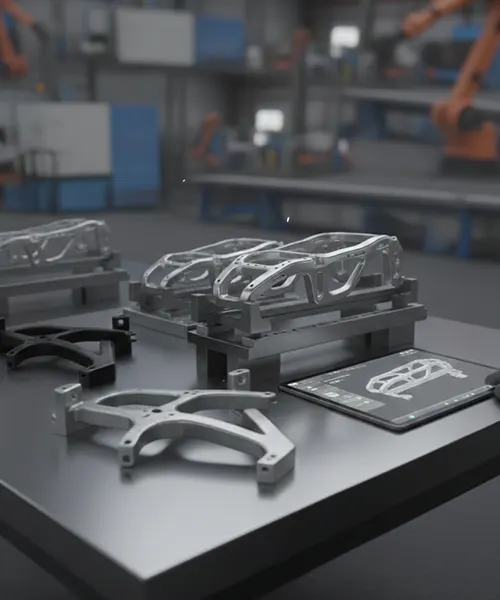
Product prototyping services help validate critical design decisions before committing to tooling, materials, and production investment.
Prototyping enables validation of form, fit, and function early in the product development cycle. By converting digital concepts into physical parts, teams can evaluate geometry, interfaces, and usability before committing to tooling or volume manufacturing.
Prototypes function as decision-making tools. Design risks identified during prototyping help prevent downstream revisions, tooling modifications, and production delays with higher cost and impact.
Alpha Foundry Tooling builds purpose-driven prototypes aligned with manufacturing realities. Geometry, tolerances, material behavior, and assembly logic are defined early to strengthen design confidence and production readiness.
Role of Product Prototyping in Product Development
Early physical validation reduces uncertainty before investments in tooling, materials, and scale are finalized.
Well-executed product prototyping enables:

Early exposure to tolerance and interface issues


Design feedback based on handling and use

Faster refinement without production-level risk
Key Benefits of Product Prototyping Services
Prototypes help resolve design, assembly, and manufacturing questions that are difficult to address digitally through CAD alone, especially in rapid prototyping and early-stage product development.
Design Accuracy Confirmation
CAD-driven prototype manufacturing verifies geometry, interfaces, and dimensional accuracy before downstream manufacturing decisions are finalized.
Material and Process Approximation
Selected materials and rapid prototyping methods simulate production behavior where required, supporting evaluation of strength, weight, and surface characteristics.
Assembly and Integration Evaluation
Multi-part functional prototyping builds allow teams to test alignment, fastening strategies, tolerances, and component interaction under realistic conditions.
Accelerated Design Iterations
Short build cycles in rapid prototyping services enable faster feedback and design refinement without waiting for production tooling.
Reduced Downstream Risk
Design issues identified during product development prototyping reduce the risk of costly tooling changes, scrap, and schedule disruption.
Product Prototyping Services Capabilities & Technical Specifications
These parameters outline the range, methods, and technical depth available within our product prototyping services, including rapid prototyping, CNC prototype machining, and hybrid manufacturing approaches.
| Parameter | Specification |
|---|---|
| Prototype Types | Concept models, functional prototypes, pre-production samples |
| Design Inputs | 3D CAD files, engineering drawings, or concept data |
| Manufacturing Methods | CNC machining, additive manufacturing, hybrid builds |
| Material Options | Plastics, metals, resins, and engineering-grade composites |
| Dimensional Control | Process-appropriate tolerance verification |
| Batch Size | Single units to limited pilot quantities |
| Surface Finish | Functional, cosmetic, or as-built finishes |
| Engineering Support | Manufacturability and design refinement feedback |
| Validation | Fit checks, assembly trials, and dimensional inspection |
Industries That Use Product Prototyping
Product prototyping services support development programs across industries where early validation directly impacts cost, performance, and time-to-market.
Consumer and Industrial Products
Medical and Laboratory Equipment
Automotive Components and Sub-Assemblies
Capital Equipment and Machinery Parts
Electromechanical Housings and Systems
Why Choose Our Prototyping Services
Prototyping delivers value when it reduces uncertainty and supports confident production decisions. Our approach is built around consistency, engineering discipline, and alignment with downstream manufacturing realities.
Clear Purpose Defined Before the First Build
Every prototype begins with agreed validation goals ensuring time, effort, and cost are directed toward the right questions, not unnecessary iterations.
Design Decisions Tracked Across Iterations
Changes are documented and evaluated so learning from each build carries forward, rather than resetting with every revision.
Objective Feedback Based on Physical Evidence
Prototype outcomes are reviewed against measured results, supporting fact-based decisions instead of subjective interpretation.
Consistent Handover To ward Production
Information generated during prototyping is structured to support tooling, pilot builds, and manufacturing teams without loss of intent.
Improve Product Decisions Through Structured Prototyping
We support product teams by converting concepts into validated prototypes that reduce uncertainty, accelerate refinement, and enable confident transitions to production.
FAQs
What is product prototyping used for?
Teams rely on product prototyping to evaluate design feasibility, validate form and fit, test functionality, and identify issues before committing to tooling or mass production.
How many prototype iterations are typically required?
Iteration count depends on design complexity and validation objectives. Some products require a single build, while others progress through multiple refinement cycles.
Can prototypes be manufactured using production-grade materials?
Yes. When required, prototypes can be produced using materials that closely match final production specifications to assess performance and durability.
How does prototyping reduce overall development cost?
By identifying design and assembly issues early, prototyping prevents expensive tooling changes, production scrap, and delays – significantly lowering total development risk.