
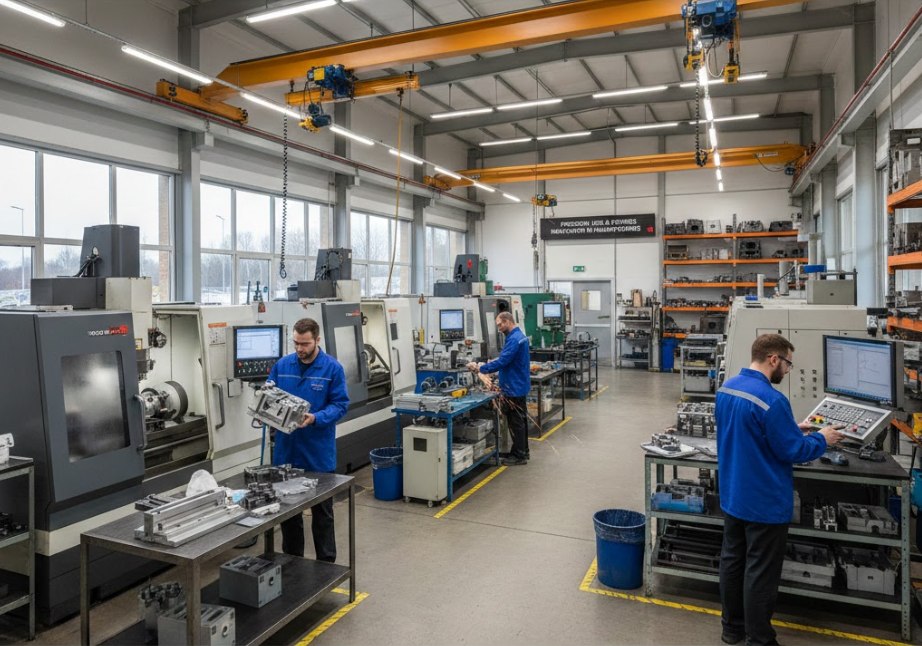
The jigs and fixtures manufacturing serves as a critical component for contemporary industrial production, which needs to achieve both high precision and continuous output of products. Manufacturers use jigs and fixtures in mass production facilities to achieve exact component placement,t which enables them to produce identical parts at the same standard throughout their production run of thousands of items. The process of manufacturing jigs and fixtures enables companies to produce goods more rapidly because it decreases manual variation, along with setup duration. Manufacturers in various industries, from automotive and aerospace to heavy engineering and consumer goods, depend on well-designed jigs and fixtures to achieve tight production tolerances while they control expenses, decrease production errors, and sustain dependable manufacturing results.
Understanding the Difference Between Jigs and Fixtures
The production of jigs and fixtures creates tools that enhance both machining and assembly processes through improved precision and consistent performance. The two elements are necessary for mass production, yet they have distinct functions during manufacturing processes.
- Jigs operate as guiding systems that direct cutting tools to follow specific paths throughout the machining process.
- Fixtures function to hold workpieces securely while maintaining their exact position throughout the maker’s process.
- Jigs serve as essential tools for performing drilling, tapping, and other tasks.
- The industry uses fixtures for their application in CNC machining, milling, and welding operations.
Importance of Jigs and Fixtures in Mass Production
The production of jigs and fixtures enables manufacturers to produce high-quality products needed for their large-scale manufacturing operations. The system allows manufacturers to create identical parts through an efficient production process.
- The solution guarantees consistent output throughout all production cycles during high-volume manufacturing.
- The solution decreases the need for operators to possess advanced skills.
- The system enables factories to maintain their production processes without any interruptions throughout the day.
- The process enables manufacturers to achieve better accuracy in their repeated tasks.
Role of Jigs and Fixtures Manufacturing in Precision Engineering
Precision engineering needs jigs and fixtures manufacturing because these tools provide accurate measurement of dimensional control.
- The system ensures the correct placement of tools together with workpieces.
- The system reduces machining errors by controlling tolerance limits.
- The system enables the creation of complex shapes that meet exacting design requirements.
- The system improves operational dependability for industries that require precise measurement systems.
Enhancing Production Speed and Efficiency
Jigs and fixtures production makes manufacturing processes more efficient through faster production times and shorter equipment setup durations.
- Workpiece loading and unloading operations become faster.
- The machine reduces its idle time.e
- The system supports rapid machining procedures.
- The system enhances operational efficiency throughout mass production processes.
Cost Optimization Through Jigs and Fixtures Manufacturing
Manufacturers use effective jigs and fixtures production methods to achieve cost savings throughout their operational and manufacturing processes.
- The system decreases labor expenses because it provides automation functions.
- The process decreases material waste while eliminating the need for rework.
- The system decreases equipment unavailability periods together with its associated maintenance requirements.
- The method provides better cost efficiency for each produced unit in large-scale production.
Improving Workplace Safety and Operator Ease
The process of manufacturing jigs and fixtures establishes a vital function that protects workers while enhancing operational productivity in mass production environments. Properly designed jigs and fixtures ensure stable workpiece positioning, which prevents workpiece movement during machining and assembly work. The stability of the system maintains safe operations while protecting tools and products from damage and enabling operators to perform their tasks with complete safety and control.
- Workplace injuries become less likely when workers use secure methods to clamp and position equipment.
- The danger of workplace accidents decreases when workers face fewer opportunities to handle heavy or sharp components.
- Ergonomic design in jigs and fixtures creates equipment that decreases physical strain while reducing worker fatigue.
- The system requires less operator skill, which leads to a decrease in human mistakes.
- Mass production operations experience better workflow through consistent setups, which create a more efficient process.
Standardization and Interchangeability in Mass Production
The production of jigs and fixtures creates standardized manufacturing methods, which are necessary for executing mass production processes.
- The system provides components that can be used as replacements without needing additional modifications.
- The system enables organizations to conduct quality assessment procedures and inspection activities more efficiently.
- The system maintains regular production processes by providing operational support throughout the entire production cycle.
- The system enables operators to acquire their required skills in less time.
Integration of Jigs and Fixtures with CNC and Automated Systems
The current production of jigs and fixtures requires CNC machining and automation technologies as essential components of its manufacturing process.
- The system operates with CNC machines to deliver accurate performance through its built-in repeatability function.
- The system supports both robotic systems and automatic production lines for its operational needs.
- The system enables accurate results during automated processes that operate at high speeds.
- The system functions as an essential component that supports the operation of intelligent manufacturing systems.
Materials and Design Considerations in Jigs and Fixtures Manufacturing
The selection of appropriate materials and design elements stands as the fundamental requirement for achieving durability and accuracy in the jigs and fixtures manufacturing process.
- Manufacturing facilities typically use hardened steel, aluminum, and cast iron as their standard materials.
- The design process prioritizes two main objectives, which include creating structures that maintain their shape and developing materials that withstand wear.
- The use of modular design systems enables organizations to create flexible systems that can be expanded to accommodate future growth.
- The use of custom jigs and fixtures enables factories to produce their specialized production requirements.
Industry Applications of Jigs and Fixtures in Mass Production
The manufacturing of jigs and fixtures provides services to multiple industries that require their products to be produced in large quantities.
- The following two sectors produce automotive and auto components products:
- The field of aerospace and defense engineering
- The production process of electronics and electrical equipment
- The manufacturing industry produces heavy machinery and industrial equipment products.
Quality Control and Consistency Enabled by Jigs and Fixtures
The manufacturing process of jigs and fixtures directly impacts the quality control standards, which are maintained throughout all production periods.
- The system assures that all components will maintain their specified measurements throughout the entire production process.
- The system decreases both inspection errors and product defects.
- The system provides support for monitoring production processes through statistical methods.
- The system helps organizations reach their target of achieving no manufacturing defects throughout the production process.
Future Trends in Jigs and Fixtures Manufacturing
The development of jigs and fixtures manufacturing requires advanced technological solutions together with digital transformation processes.
- The adoption process of CAD/CAM systems, together with digital simulation tools, has begun.
- Additive manufacturing enables companies to create tools in a quick production process.
- Smart jigs use sensors together with IoT technology for operational functions.
- Companies now prioritize flexible systems that enable them to produce customized products in large quantities.
Conclusion
Jigs and fixtures manufacturing is a fundamental process that enables factories to produce goods in large quantities while maintaining dependable operational performance. The use of jigs and fixtures allows manufacturers to achieve their production targets because these tools enhance accuracy, decrease expenses, increase workplace safety, and facilitate production automation. The manufacturing of jigs and fixtures will become more important for industries that develop smart factories and advanced manufacturing systems because these technologies need standardization to achieve productivity and permanent operational success.
FAQs
1. What is the role of jig and fixtures makers in mass production?
Jigs and fixtures manufacturing delivers 3 vital elements that manufacturers need to produce high-quality, identical products in bulk.
2. How do jigs and fixtures improve production efficiency?
The system achieves production speed enhancements through its capacity to decrease setup durations and cut down on user mistakes while generating quicker machining and assembly processes.
3. Are jigs and fixtures necessary for CNC and automated manufacturing?
The system establishes essential workpiece stability for CNC machines, robotics, and automated mass production systems because it maintains secure workpiece positioning.
4. Which industries benefit most from jigs and fixtures manufacturing?
All jigs and fixtures manufacturing operations serve as essential equipment for automotive, aerospace, electronics, heavy engineering, and consumer goods manufacturing.
5. How do jig and fixtures makers help reduce production costs?
The use of jigs and fixtures in high-volume manufacturing leads to decreased production expenses because they help businesses reduce material waste, rework needs, labor requirements, and machine downtime.