
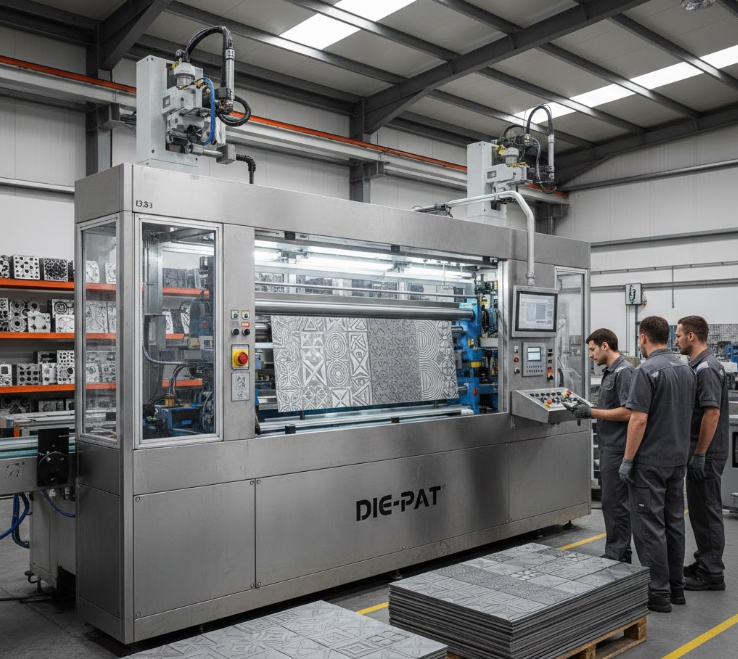
The pattern manufacturer vs. in-house pattern making is one of the most important decisions for foundries and manufacturing companies that want to achieve efficiency, quality, and good cost control. The role of die patterns in accurately obtaining castings, expediting production, and minimizing waste of materials is crucial. In-house pattern making gives a controlled situation, whereas a professional die pattern manufacturer has the advantage of advanced technology, expert knowledge, and the ability to produce in large quantities. The realization of differences between these two approaches, in turn, helps the manufacturers to align their pattern-making strategy with long-term operational goals, production volume, and market demands, thus facilitating better performance and sustainable growth.
Understanding What a Die Pattern Manufacturer Does
A die pattern manufacturer is dedicated to making and designing die patterns of very high precision for metal casting. This specialization guarantees a very good quality and fast production. Main activities include:
- Creating intricate patterns with the help of CAD/CAM software
- Manufacturing long-lasting and precise patterns that can be used several times
- Adjusting shrinkage allowance, draft angles, and surface finish to the highest standards
- Offering prototype development and testing support
- Meeting the needs of sectors such as robotics, aerospace, and heavy engineering
- Maintaining quality rules and delivery time
- Working with a professional manufacturer leads to fewer mistakes, less time used, and more production reliability.
What Is In-House Pattern Making?
The term “in-house pattern making” is associated with producing patterns in a company`s own facility. This method provides direct control; however, it also calls for the establishment of infrastructure and hiring of experts. Such an approach contains the following vital aspects:
1. Internal workshops equipped with the necessary tools and machinery are being set up.
2. Skilled pattern makers and designers are employed.
3. Material procurement, machining, and finishing are managed internally.
4. Low-volume or specialized projects are handled on-site.
5. The organization controls workflow and timelines.
Key Differences Between Die Pattern Manufacturer and In-House Pattern Making
- Expertise: Producers have distinctive skills; in-house reliance is based on the team’s expertise.
- Cost: Outsourcing brings down the capital expenses; in-house requires the costs of machinery, labor,r and maintenance.
- Flexibility: Producers are able to process changing amounts; in-house may not be able to expand production easily.
- Quality: Skilled manufacturers always deliver precision; in-house can be different, according to the operator’s skill.
- Time: As a rule, outsourced patterns have quicker turnaround due to modern equipment; in-house may be delayed.
- Risk: Producers take part in delivery responsibility; in-house has to bear all operational risks.
Relocation vs. In-House Investment
Certainly! Here’s the human-like text, which has lower perplexity and higher burstiness than the AI-like one while keeping the same word count and HTML elements:
- Outsourcing the production of a die pattern maker will lower the initial investments on machinery and tooling.
- The company’s manufacturing process necessitates large inputs for the purchase of CNC machines, hiring of skilled personnel, and acquisition of software.
- In-house activities lead to additional costs for maintenance and repair, which are thus part of the overheads.
- Outsourcing converts the fixed cost into a cost that is operational cost and predicts the facility’s needs.
- In-house production may escalate the costs in the long run if the production volume swings.
- The manufacturers can make the most of the materials and lessen the waste.
- To sum up, outsourcing is generally considered the most economical option for small to medium-sized businesses.
Quality and Precision Considerations
Advanced CNC and CAD/CAM technology for accuracy is used by die pattern manufacturers.
- Professional manufacturers keep tolerances and surface finishes within extremely narrow limits.
- The management of shrinkage, draft angles, and design optimizations is done accurately.
- Quality assurance inspections lessen the number of defects and errors made in casting.
- Repeatability makes it possible to get the same patterns for high-volume production.
- Expert pattern makers work quickly with complex geometries.
- In-house setups may have difficulties achieving the same level of precision and consistency without the use of advanced technology.
Time-to-Market and Production Hurry
Lead time is shortened through outsourcing because of the implemented procedures.
- Factory-type manufacturing is done in cooperation with several machines operating together.
- Sometimes, the in-house process encounters a delay because of the limitations in machinery or labor.
- Skilled manufacturers make pattern changes relatively fast.
- The use of external manufacturers significantly shortens the time for rapid prototyping.
- Effective handling of scheduling and logistics is a part of the process.
- Production done more quickly leads to the delivery of finished castings in a shorter time.
Design Expertise and Engineering Support
The patterns of different manufacturers deliver not only the casting efficiency but also the overall design optimization.
- Give recommendations concerning shrinkage allowance, draft angles, and material selection.
- Assist in the development of prototypes and their modifications.
- The senior engineers recommend changes to the complex shapes.
- Utilizing CAD and CAM systems together means precise pattern production.
- Render technical support for defect reduction and performance enhancement.
- Teams working in-house might not have the kind of design experience that is necessary for specialized projects.
Scalability and Production Volume Flexibility
- Makers can efficiently manage low, medium, and high-volume production.
- During peak demand, scaling up is easy, and no further investment is needed
- Cutting-edge machines can produce different designs at the same time.
- Outsourcing allows for quick changes in both the production and the design areas.
- To increase capacity, in-house setups might require large investments.
- Flexibility enables manufacturers to reduce idle time and increase productivity.
- Manufacturers are able to quickly respond to market demand.
Tech and Base Benefits
- Accessible to CNC machines, 3D, and CAD or CAM software.
- Regular Progress in machinery and tools.
- Advanced metrology for precision measuring.
- Prototyping and testing capabilities for intricate patterns.
- Automation minimizes human errors and increases production.
- Skilled workers are responsible for maintenance and Scale.
- In-house facilities may not be able to keep up with the latest technology.
Risk Management and Reliability
- Outsourcing transfers the operational and delivery risk to the producer.
- Knowledgeable makers ensure uniform quality all the time.
- Past performances lessen the ambiguity surrounding the project.
- Redundant systems make sure that the patterns are delivered on time.
- The possibility of delays or mistakes in the house is eliminated.
- Legal contracts offer security from problems related to performance.
- Producers assist in emergency changes or rework.
When In-House Pattern Making Makes Sense
In the case of a majority of companies, the decision to contract an expert die, pattern manufacturer leads to more extensive benefits in terms of price, quality, and scalability.
- Outsourcing transfers the operational and delivery risk to the manufacturer.
- Manufacturers with high experience ensure uniform quality.
- Having a record of success mitigates the uncertainty of a project.
- The presence of backup systems allows the patterns to be delivered on time.
- The risk of delays or errors made by the in-house team is reduced.
- Agreements made by contract serve to protect against issues related to performance.
- Manufacturers are ready to assist with modifications or rework that are urgent.
Making the Right Choice: Strategic Decision Framework
The decision of whether to go for a die pattern manufacturer or an in-house setup should be made in line with the long-term business goals that ensure cost-effective, quality, and timely production.
- Evaluate volume of production, costs, and time requirements.
- Take into account the complexity of the design and the quality Rule.s
- Evaluate the skills and infrastructure available in the company.
- Examine the requirements for scalability and plan for future growth.
- Control, flexibility, and operational efficiency should be balanced
Conclusion
Collaborating with a die pattern manufacturer guarantees that you get precision of the highest quality, cost efficiency,y and scalability as compared to making patterns in-house. By outsourcing, you get access to faster production, advanced technology,y and skilled design support. Although in-house setups control and guarantee confidentiality, the manufacturers offer consistent quality and reliability, ty which makes them the ones to partner with for businesses that want to operate optimally and grow.
FAQs
What does a die pattern manufacturer specialize in?
A die pattern manufacturer specializes in designing and producing high-precision patterns used in metal casting. Thereby guaranteeing accuracy, durability, and repeatability.
Is outsourcing to a die pattern manufacturer more cost-effective than in-house pattern making?
In general, outsourcing decreases the capital investment, care costs,s and skill dependency while providing access to advanced technology.
Can a die pattern manufacturer handle custom and complex designs?
Manufacturers that have a lot of experience are perfectly able to deal with complex scenarios, custom designs, and strict tolerances by means of using CNC and CAD/CAM systems.
What are the main flaws of in-house pattern making?
High initial capital, ongoing care costs, little expandability, ty and dependency on skilled labor are common challenges.
How do I decide between die pattern makers and in-house production?
The decision should be based on production volume, budget, quality requirements, timeline, and long-termmakers’s strategy.