
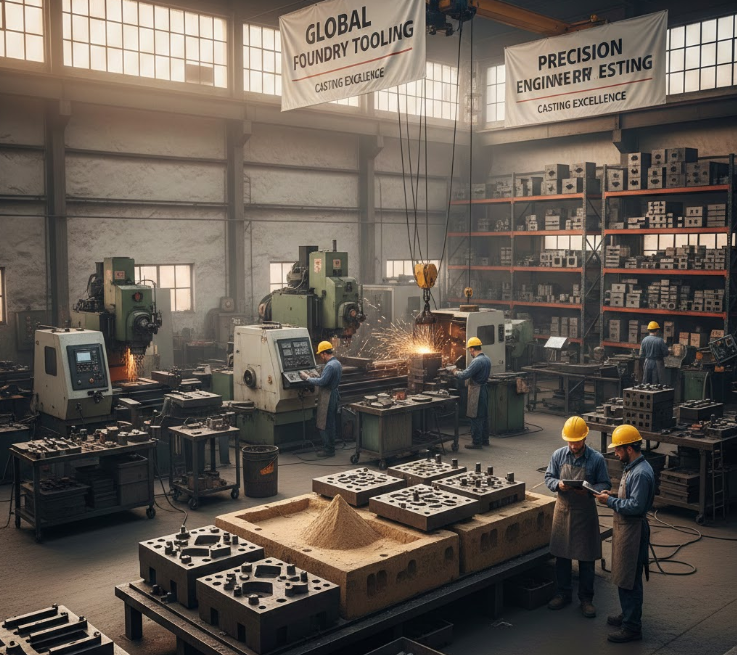
Foundries must reduce their lead times because customers require faster delivery at unchanged quality standards. The conventional techniques of tooling production lead foundry tooling manufacturers to experience extended product development times, which they must repeatedly adjust until they reach their final production timetable. The implementation of agile foundry tooling provides an intelligent, flexible solutionthath combines digital design tools with rapid prototyping capabilities and team-based work processes. Through agile methods implementation, foundry tooling manufacturers gain the ability to rapidly adjust to design changes while reducing the need for additional work and increasing their product launch speed. This transformation enhances both operational performance and business competitive strength in a manufacturing environment that increasingly values speed.
Understanding Lead Times in Foundry Tooling
The complete period extends from the approval of the tooling design until the equipment becomes operational for manufacturing. The foundry tooling manufacturers experience extended lead times because their designs require multiple revisions and complex designs, and they depend on manual workflows.
- The design process needs to be approved first before anyone can start the engineering design modifications.
- The process of producing and machining tools requires a substantial amount of manufacturing time.
- The combination of trial runs and rework activities creates unforeseen project hold-ups.
- The increased length of lead times leads to higher expenses, which disrupt the scheduled customer delivery times.
What Is Agile Foundry Tooling?
The Agile Foundry tooling system provides organizations with an adaptable development framework that enables them to create new tools while managing ongoing design changes. The system enables foundry tooling manufacturers to rapidly adapt their operations according to changing customer demands.
- The system needs to be developed through ongoing design work and implementation of better design elements.
- The system requires different departments to work together as one team.
- The system uses digital tools to achieve faster validation results.
- The system decreases operational downtime, which occurs when changes are introduced at the final production stage.
Challenges of Traditional Foundry Tooling Methods
The basic operating system of traditional tooling methods depends on their requirement to process tasks through predefined sequential steps, which use permanent design specifications. The limitations of these systems create operational difficulties for foundry tooling manufacturers who need to compete in fast-changing market environments.
- The design process becomes restricted because designers cannot implement changes to their existing rigid tooling systems.
- The production process experiences delays because all work needs to be done by human operators.
- The extended time needed to complete projects results from increased rates of product corrections that require testing.
- The production process lacks complete visibility because all tooling stages of development remain hidden from view.
Role of Digital Design & Simulation in Reducing Lead Time
The development of digital design and simulation tools drives faster tooling development for foundry manufacturing because these tools enable early detection of problems during the development process.
- The integration of CAD and CAM systems, together with Fusion 360 software, results in improved design precision.
- The simulation process estimates production defects before the actual manufacturing process begins.
- The reduction of physical testing results in decreased need for rework.
- The total production time decreases because approval processes are completed at a faster rate.
Rapid Prototyping and Additive Manufacturing in Foundry Tooling
The combination of rapid prototyping and additive manufacturing technologies allows for faster design testing, which leads to quicker validation of tooling designs. The technologies enable foundry tooling manufacturers to achieve substantial reductions in their development time.
- The process enables the rapid creation of both patterns and core boxes.
- The process enables quicker verification of designs through testing.
- The process decreases the need for traditional machining methods.
- The process results in decreased development time and reduced expenses for both development and tooling costs.
Modular and Standardized Tooling Concepts
The standardized modular system enables foundry tooling manufacturers to use their components during different projects, which results in faster production processes and higher operational effectiveness.
- Interchangeable tooling components
- The process of setup and changeover requires less time because of this system.
- The system enables organizations to efficiently adjust their operations between different production levels.
- The system enhances operational uniformity throughout all tooling development projects.
Agile Project Management in Tooling Development
Agile project management increases operational efficiency for foundry tooling manufacturers by helping teams work together better and thus making decisions faster through its system of transparent operations and ongoing feedback.
- The process requires teams from different departments to work together.
- The team operates with brief development periods, which include assessment sessions at fixed times.
- The team can identify work obstacles before they become major issues.
- The team can implement design adjustments at a quicker pace.
Supplier Collaboration and Integrated Supply Chains
The foundry tooling manufacturers achieve operational efficiency through their collaborative work with suppliers, which enables them to solve material shortage problems and communication breakdowns.
- The first step of the process requires suppliers to become involved in the designing of tooling systems.
- The system enables supply chains to exchange information on their current operational status.
- The system decreases the time required to complete procurement processes.
- The system enables better production planning together with enhanced scheduling capabilities.
Quality Control and In-Process Inspection for Faster Turnarounds
The foundry tooling manufacturers use quality checks during their production process to maintain their operational speed while maintaining their operational speed without sacrificing their production accuracy.
- The process of emphasizing real-time inspection throughout tooling fabrication work.
- The process of finding dimensional deviations in their initial form leads to better operational results.
- The process of rejection and rework has been reduced.
- The organization has achieved quicker final approval processes, which have resulted in faster delivery times.
Case Impact: How Agile Tooling Reduces Time-to-Market
Agile tooling allows foundry tooling manufacturers to shorten their product development cycles because it enables them to respond faster while decreasing their operational delays.
- The length of design-to-production cycles has been decreased.
- The company now completes customer-requested changes at a quicker rate.
- The business achieved better results because its products reached customers on time.
- The company succeeded because it enhanced customer satisfaction, which led to increased customer retention.
Future Trends in Agile Foundry Tooling
The developing technologies of today create new possibilities for foundry tooling manufacturers to improve their agile tooling methods, which results in shorter lead times.
- The use of artificial intelligence for production equipment design leads to more efficient design processes.
- The development of smart tooling systems includes Internet of Things monitoring capabilities.
- The system uses advanced simulation technology together with digital twin technology to operate its functions.
- The system now implements more automated systems to handle its entire tooling operations.
Conclusion
Agile foundry tooling enables foundry tooling manufacturers to achieve better operational efficiency through shorter lead times. Digital design,n together with rapid prototyping, modular tooling, and collaborative workflows, enables manufacturers to speed up their production processes without losing product quality. The implementation of agile tooling will continue to support organizations in meeting customer requirements while achieving faster delivery and cost savings and maintaining their ability to compete in the market.
FAQs
1. What is Agile Foundry tooling?
Agile foundry tooling focuses on flexible, iterative, and technology-driven tooling processes that enable faster design, development, and creation cycles.
2. How does agile tooling help reduce lead times?
The implementation of digital design and rapid prototyping, modular tooling, and collaborative workflows enables agile tooling to decrease rework while increasing speed of decision-making.
3. Is agile tooling suitable for all foundry tooling manufacturers?
Agile practices can be implemented by both small and large foundry tooling manufacturers who can adjust their use of scaling tools and processes according to their actual production needs.
4. What technologies are most important for agile foundry tooling?
The essential technologies for agile foundry tooling comprise CAD/CAM software, simulation tools, additive manufacturing, automation, and real-time quality inspection systems.
5. Does Agile Foundry tooling compromise quality for speed?
The implementation of agile tooling improves quality when applied correctly because it helps organizations find problems early and supports ongoing development through the entire tooling process.