
RUBBER CONVEYOR BELT MANUFACTURER IN INDIA
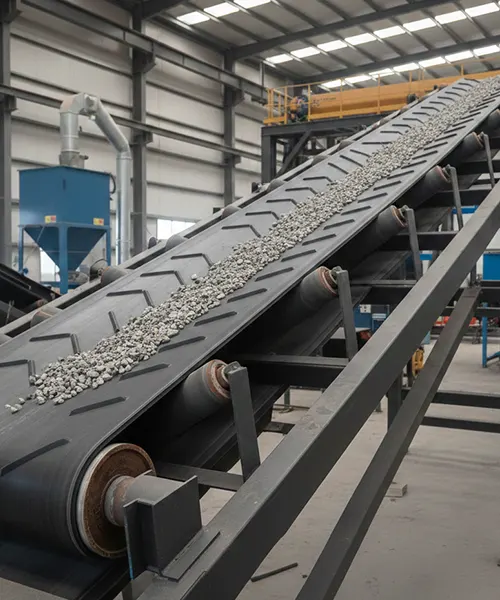
Alpha Dies & Pattern is an established manufacturer of rubber conveyor belts in India, supplying industrial belts for bulk material handling, manufacturing and material transport applications. Available in different rubber grades, thicknesses and profile designs, our belts meet diverse industrial requirements. Our product range includes cleated, chevron, sidewall and heat-resistant rubber conveyor belts for applications involving inclined conveying, abrasive materials and elevated operating temperatures.
Rubber conveyor belts are available in different specifications to suit the materials being transported and the operating conditions. Key selection factors include rubber grade, belt thickness, profile design and application requirements. This guide covers the main types, technical specifications and selection considerations to help you choose the right rubber conveyor belt manufacturer in India.
What Are Rubber Conveyor Belts
Rubber conveyor belts are, as the name suggests, rubber belts of varying thickness used with a conveyor system. They move a range of products and materials across varying inclines and declines. They can be flat and used to move packages from point A to B, or can have different types of raised profiles for moving ores, coal, agricultural produce, fertilizers, and other loose, damp, and clumpy materials.
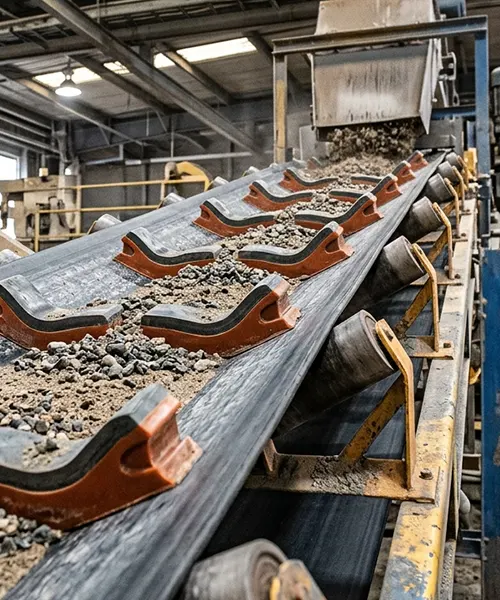
Rubber conveyor belts typically consist of three main layers. The top rubber cover contacts the conveyed material and may include raised profiles to help control material movement. These profiles may be mechanically attached or vulcanized in place, depending on the belt design.
The middle layer, known as the carcass, provides structural strength and may use textile fabrics, such as nylon or polyester, or steel cords, depending on the belt construction and load requirements. The bottom rubber cover contacts the conveyor pulley system and helps protect the carcass from wear.
These layers are held together by industry-grade adhesives with high temperature resistance. Together, these three parts constitute a rubber conveyor belt.
Where Are Rubber Conveyor Belts Commonly Used
Rubber conveyor belts are a staple of multiple industries. They can be found in packaging warehouses, logistics hubs, ports, and all other places that handle cargo or packaging at scale. They are also visible in agricultural processing units where different types of rubber conveyor belts move raw, semi-processed, and processed products within the same facility.
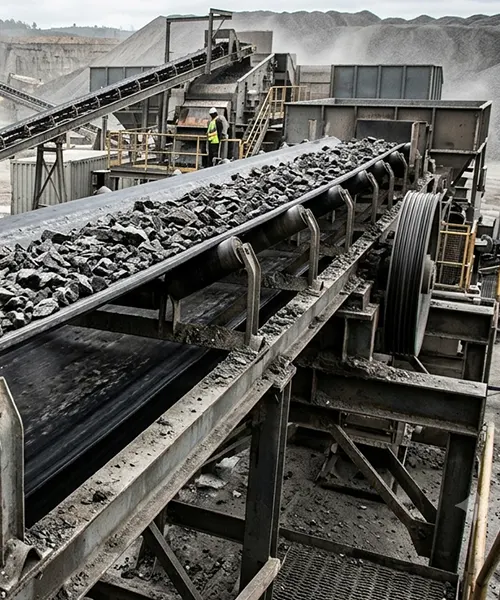
However, rubber conveyor belts are most visible in heavy industries such as mining, cement production, metals, recycling, and such, where abrasive and challenging materials need to travel long distances and often at sharp inclines.
Different Types of Rubber Conveyor Belts and Their Uses
Different types of rubber conveyor belts are designed for specific material-handling requirements, operating environments and conveyor layouts. Alpha Dies & Pattern manufactures cleated, chevron, sidewall and heat-resistant rubber conveyor belts for applications involving inclined conveying, bulk material transport and elevated temperatures.
Cleated rubber conveyor belts
These belts have different types of cleats, i.e., lugs for separating the material or product being transported. Popular variants include T, L, C (scoop), Inclined, and gusset profiles. Cleated rubber conveyor belts are quite versatile, capable of moving items at a gentle slope (~15°) and at challenging inclines (90°).
Chevron rubber conveyor belts
Chevron rubber belts are similar to cleated belts but use only the herringbone pattern for cleats. Popular cleat profiles include V, U, and Y. Of these, the V pattern is more widely used and is available as open V and closed V. Open V is frequently used to move damp or wet material, where movement at an incline helps drain water.
Sidewall rubber conveyor belts
Sidewall conveyor rubber belts are also called accordion rubber conveyor belts because of their S-shaped or accordion pattern on the side. These belts are primarily used for moving heavy materials and usually have vertically tall cleats in the T, L, or Scoop profiles. The raised S-shaped edges create natural pockets that prevent materials from falling off the side at steep angles while also providing greater elasticity at the turning point. This greatly increases their service life but demands a little more maintenance than flat bed rubber belts.
Heat-resistant rubber conveyor belts
These belts have more to do with the heat quotient of the rubber rather than a physical feature per se. Since they primarily move hot materials and are made from fire-resistant and heat-resistant rubber, they usually have reinforced cleat profiles that complement the top rubber grade. These belts are widely used in moving hot ash, metal sludge, cement clinkers, and asphalt because of their excellent heat resistance.
Technical Specifications of Rubber Conveyor Belts
Rubber conveyor belt specifications should match the conveyed material, operating environment and conveyor design. Key selection parameters include top and bottom cover thickness, carcass construction, belt width, rubber grade, surface profile and splicing requirements. These specifications help determine a suitable belt configuration for the intended application.
| Particulars | Details |
|---|---|
| Top rubber thickness | 3 mm – 20 mm |
| Bottom rubber thickness | 1 mm – 20 mm |
| Carcass ply count | 2 ply – 6 ply |
| Carcass ply material | NN (nylon), Polyester (EP), Steel Cords |
| Profile types | V, U, Y, T, L, C (Scoop), Inclined, Gusset, etc. |
| Belt width | 400 mm – 1600 mm |
| Belt rubber grades | N17, M24, HR, OR, FR, White hygienic, etc. |
| Splicing | Cut, Ready-to-splice, Spliced |
| Compliance | ISO 283, ISO 505, ISO 284, ISO 340, ISO 4195, ISO 1431 |
How to Choose a Rubber Conveyor Belt Manufacturer in India
Choosing the right rubber conveyor belt manufacturer in India involves evaluating manufacturing capabilities, product specifications, quality management, customization options and delivery reliability. Consider the following factors when selecting a supplier for your industrial material-handling requirements.
Industry certifications
Look for ISO 9001 certification and other relevant quality credentials when evaluating a rubber conveyor belt manufacturer. These certifications can help assess the supplier’s quality management processes and commitment to consistent production practices.
Industry exposure
Choosing a partner with relevant industry experience, such as supplying to heavy industries or agribusinesses, is beneficial. This saves you from unwelcome surprises down the line, such as project delays and additional expenses that raise the total cost of ownership.
Years in Operation
Experience in rubber conveyor belt manufacturing can indicate industry knowledge, product development capabilities and operational stability. An established supplier may also provide ongoing after-sales support and technical guidance.
Technical and export compliance
A technically sound rubber conveyor belt manufacturer can advise you on the right belt parameters, saving you considerable expenses down the line. The same applies to export, where awareness of local laws and customs rules for your port of destination can save project man-hours and transport expenses.
Why You Should Choose Alpha Dies & Pattern for Rubber Conveyor Belt Manufacturing
Alpha Dies & Pattern is an established rubber conveyor belt manufacturer in India, supplying customized conveyor belt solutions to OEMs, aftermarket suppliers and industrial customers across domestic and international markets. Our product range includes cleated, chevron, sidewall and heat-resistant rubber conveyor belts designed for different material-handling applications.
- 20-plus years of industry experience
- Established supplier to belt OEMs and aftermarket suppliers
- Experience in catering to heavy industries, agricultural and F&B businesses, and general industries
- Supplies and exports rubber conveyor belts to international markets
- Rigorous internal testing and ISO compliance
- ISO 9001:2015 certification
- Agile production processes, one-to-one technical support, and scheduled delivery coordination
Discuss Your Rubber Conveyor Belt Requirements
Discuss your rubber conveyor belt requirements with our team. We can help you evaluate suitable belt specifications, including carcass construction, rubber grade, belt thickness and profile design, based on your application needs.
Explore Our Range of Rubber Conveyor Belts

FAQs
What are cleats in rubber conveyor belts?
Cleats are the separators in the conveyor belts. They are also called profiles or lugs, and are available in multiple patterns. They can be as short as 6 mm and as tall as 120 mm or possibly more, depending on the materials they are to transport.
What is a pitch in rubber conveyor belts?
Pitch is the distance between two cleats, measured from the tip of one cleat to the next. Pitch is crucial in belts, since it works to successfully segregate the material being transported.
What incline and decline degrees do conveyor belts work in?
Conveyor belts work best between 15 and 60 degrees. Post 60 degrees and all the way to 90 degrees, they require special construction or a profile accurately mapped to their use case.
Why buy rubber conveyor belts from India?
India is an established sourcing market for industrial conveyor belt products. Buyers may evaluate Indian rubber conveyor belt manufacturers based on product specifications, manufacturing capabilities, quality requirements, pricing, export experience and delivery arrangements. The right supplier should meet the technical and commercial requirements of the intended application.
Does Alpha Dies & Pattern offer customization of rubber conveyor belts?
Yes. We offer customization of rubber conveyor belts based on application requirements, including rubber grade, profile design, top cover thickness and belt width. Our team can help assess your conveyor configuration and material-handling needs to identify a suitable belt specification.